
This post is educational for the purpose of building self-awareness. It is not a tool or substitute for professional or medical advice and should not be used to diagnose clinical depression.
When people talk about being “depressed” in a casual, everyday manner, it blurs the line between a normal emotional response of sadness to a situation with a more serious mental health condition—clinical depression. Understanding the difference between feeling sad and having clinical depression helps us to appropriately support our mental health without mislabeling our experiences.
Situational Sadness
Situational sadness is a normal emotional response to an event or experience that highlights what matters to us and signals our need for support. While situational sadness feels uncomfortable or unpleasant, it is an active, evolutionary adaptation that is designed to help us process change and loss, and helps us move towards healing. Crying and expressing sadness release endorphins and oxytocin—our body’s natural “feel-good” chemicals. Through this hormonal shift, we actively soothe emotional pain, reduce stress levels, and bring our nervous system back into balance. Suppressing situational sadness often prolongs our heartache, whereas allowing it to move through us paves the way for emotional resolution and connection.
Here are some examples of normal, appropriate and healthy situational sadness:
💔 Grief and Loss
- The death of a loved one: Feeling a deep, heavy sorrow after losing a family member, friend, or beloved pet.
- The end of a relationship: Experiencing a period of crying, longing, and emptiness after a breakup or divorce.
- A major diagnosis: Feeling sad or mourning your previous lifestyle after learning you or a loved one has a chronic illness.
💼 Life Transitions and Disappointments
- Career setbacks: Feeling discouraged, unmotivated, or tearful after a sudden job layoff or being rejected for a promotion you worked hard for.
- Moving away: Experiencing homesickness and nostalgia when leaving your hometown, friends, or family for a new city or college.
- The “Empty Nest”: Parents feeling a profound sense of quiet and sadness when their last child moves out of the house.
📉 Relational and Social Letdowns
- A falling out with a friend: Feeling a heavy heart and disappointment after a major argument or the fading of a long-term friendship.
- Missing a milestone: Feeling down or lonely when you are unable to attend a major life event, like a close friend’s wedding or a family holiday gathering.
⚖️ Empathy and Collective Sadness
- World events: Feeling weighed down or deeply saddened by distressing news stories, natural disasters, or community tragedies.
- Disappointment for others: Experiencing genuine sadness on behalf of a friend or family member who is going through a difficult season.
Sadness in this way is often tied to a specific experience or life circumstance. It is usually temporary, coming in waves, with the intensity decreasing over time with attention and care. The emotional response to the event or situation is also proportional to the severity of the circumstance, meaning that your level of sadness matches the scale of the situation.
An important thing to remember is that situational sadness can be managed with coping skills like acceptance and expression, connection and care from loved ones, and maintaining routine / behavioral anchors such as eating at regular intervals, maintaining personal hygiene, and continuing physical movement/exercise.
Depression as a Mental Health Condition
Clinical Depression is more severe, long lasting and debilitating than situational sadness, to the extent that it impacts a persons ability continue their normal/daily life. One way to think about differentiating between situational sadness and clinical depression is through the 3 Ds: Duration, Distress, and Dysfunction.
1. Duration: How long does it last?
- Situational Sadness: This emotional response is typically temporary and dissipates over time as you process an event or as your circumstances change. You might feel a wave of grief or a low mood for a few days or weeks after a difficult event, but the cloud begins to lift.
- Clinical Depression: The low mood is persistent, lasting for at least two weeks (and often months). It is present most of the day, nearly every day, and can feel like a constant shadow that doesn’t lift, even when good things happen.
2. Distress: What does the pain feel like?
- Situational Sadness: The emotional pain is usually proportional to a specific trigger—such as a breakup, a job loss, or grieving a loved one. While the pain is real, you are still able to experience brief moments of connection, humor, or hope.
- Clinical Depression: The distress is profound, overwhelming, and often feels unmanageable. It frequently presents as “free-floating” numbness, severe emptiness, intense guilt, or a complete loss of interest in things you used to love. The distress is stuck on, causing deep emotional pain without a clear or obvious current trigger.
3. Dysfunction: How does it impact your life?
- Situational Sadness: Even when you are feeling down, you can generally maintain your daily routines. You might cry or feel unmotivated, but you can still manage to show up for work, take care of your hygiene, and engage with family or friends.
- Clinical Depression: It actively interferes with your daily functioning and disrupts multiple areas of life. It can manifest physically, causing significant changes in sleep patterns (insomnia or oversleeping), shifts in appetite (over-eating or not eating), extreme fatigue, and difficulty concentrating or making simple choices.
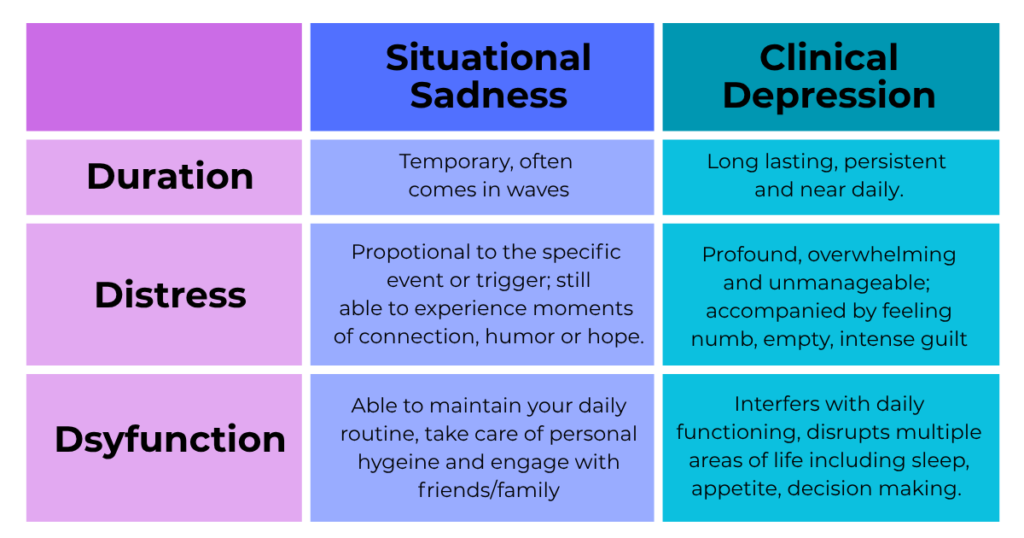
Distinguishing between normal situational sadness and clinical depression helps us to support our well-being appropriately. While situational sadness is tied to a temporary event or loss and resolves with coping skills, clinical depression is a persistent mental health condition requiring professional care.
Whether your low mood is temporary or a constant shadow, you don’t have to whether the storm alone. Reaching out for support isn’t a sign of weakness or defeat; it is an active, empowering choice to take control of your health and well-being. Schedule a free consultation with one of our mental health clinicians if you’re ready for support.
Ampersand Counseling Collective works with individuals across Washington State who are navigating anxiety, depression, and relational challenges. We offer individual therapy on Bainbridge Island and in Issaquah, as well as online therapy throughout Washington.
You can also read our post on Understanding Anxiety.