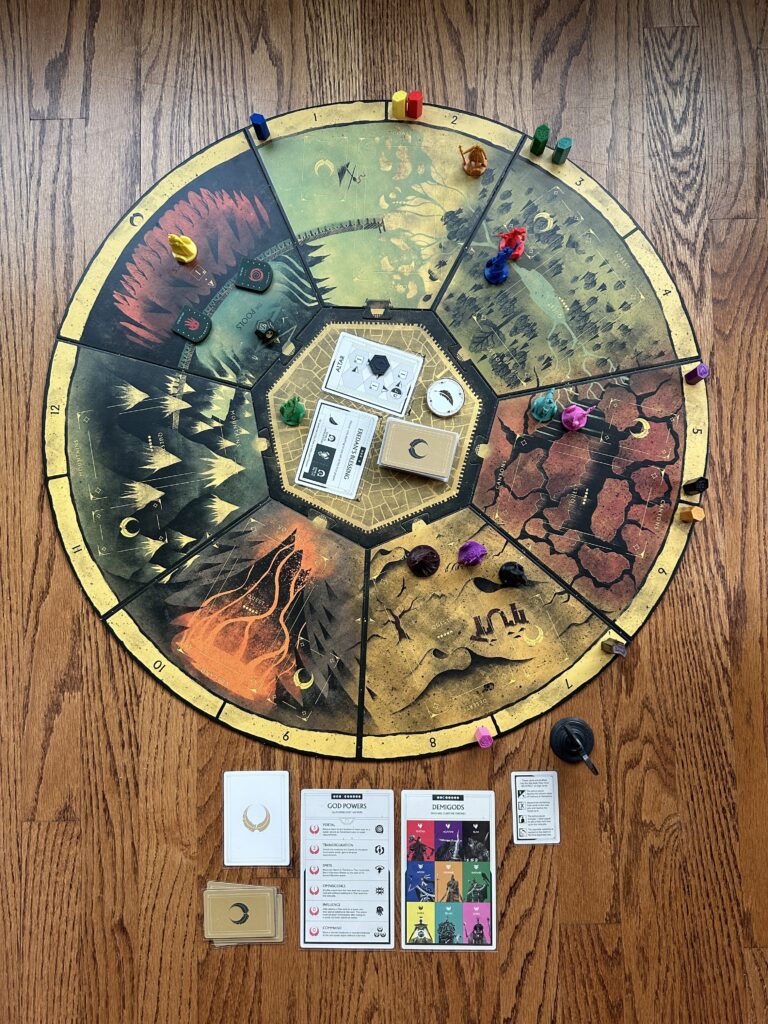
We’re excited to share that this month Maggie had an essay published in the Board Game Academics online journal Victory Points! In her essay titled Something More: Nested Realities & Desire in Veiled Fate, Maggie explored Lacanian psychoanalytic theory around desire and ‘nested realities’ through her time playing a game of Veiled Fate.
Here’s an excerpt from the essay:
I took a seat at a round folding table with six men in a church basement on a Monday night. It was my third time attending the bi-monthly meet-up of my local board gaming group, Meeples-N-More, and, as one of only two women in the room, I was curious to see how the night would unfold…
The Board Game Veiled Fate by IV Studios
On this particular night, the game being introduced was Veiled Fate,1 a game of hidden influence and strategic social deduction where players manipulate the fates of nine demigods, each posturing for renown (victory points) through quests, the outcomes of which are determined by secret votes (fate cards). With seven players that night, we worked in unknown teams, meaning another player was working towards the same goal but didn’t know who the other ‘teammate’ was until the end of the game. Having an odd number of players also meant someone was working alone; Someone was the ‘odd man out’ and didn’t know it.
As always, I started the game with eager excitement and the familiar discomfort of not knowing what I was doing—not knowing the rules or what the best strategy was for winning, and in truth, not knowing the people I was with except for one. While Veiled Fates was set up and the rules explained, I recalled a class I had taken in graduate school on the work of French Psychoanalyst Jacques Lacan. The course was called “Lacan Plays Catan,” and our professor, Dr. Hoard, used board games to help us understand psychoanalytic theory.2 Through the class, Dr. Hoard invited us to consider that somethingmore was happening while playing board games and to be curious about what psychological processes were being stirred up and activated in and between people. Seen through this theoretical lens, two phenomena I noticed during Veiled Fate werethe seamless weaving in and out of the nested realities of the board game and “real life,” and the ways various desires were brought out of me through play.
Veiled Fate is created by IV Studio. Game Design by Zac Dixon, Samuel Cowden, Maxwell Anderson & Austin Harrison. ↩︎
I have tremendous gratitude for Dr. Paul Hoard who was instrumental in my counselor training at the Seattle School of Theology and Psychology. He introduced me to the work of Lacan, which I found simultaneously dizzying and irresistible, and helped rekindle my love of and ability to play in a big way. ↩︎
Contains information related to marketing campaigns of the user. These are shared with Google AdWords / Google Ads when the Google Ads and Google Analytics accounts are linked together.
90 days
__utma
ID used to identify users and sessions
2 years after last activity
__utmt
Used to monitor number of Google Analytics server requests
10 minutes
__utmb
Used to distinguish new sessions and visits. This cookie is set when the GA.js javascript library is loaded and there is no existing __utmb cookie. The cookie is updated every time data is sent to the Google Analytics server.
30 minutes after last activity
__utmc
Used only with old Urchin versions of Google Analytics and not with GA.js. Was used to distinguish between new sessions and visits at the end of a session.
End of session (browser)
__utmz
Contains information about the traffic source or campaign that directed user to the website. The cookie is set when the GA.js javascript is loaded and updated when data is sent to the Google Anaytics server
6 months after last activity
__utmv
Contains custom information set by the web developer via the _setCustomVar method in Google Analytics. This cookie is updated every time new data is sent to the Google Analytics server.
2 years after last activity
__utmx
Used to determine whether a user is included in an A / B or Multivariate test.
18 months
_ga
ID used to identify users
2 years
_gali
Used by Google Analytics to determine which links on a page are being clicked
30 seconds
_ga_
ID used to identify users
2 years
_gid
ID used to identify users for 24 hours after last activity
24 hours
_gat
Used to monitor number of Google Analytics server requests when using Google Tag Manager
1 minute
Google reCAPTCHA helps protect websites from spam and abuse by verifying user interactions through challenges.
Name
Description
Duration
_GRECAPTCHA
Google reCAPTCHA sets a necessary cookie (_GRECAPTCHA) when executed for the purpose of providing its risk analysis.