
Over the last few months, I’ve written about tools that we can use to help ourselves feel more emotionally regulated, particularly in a polarizing social-political climate. We’ve explored why we react with big emotions, ways to calm down and self-regulate when activated, and how to listen to others when it’s outside of our comfort zone.
Independently, these three posts can give the impression that if you just do this inner work well enough, that you’ll be self-sufficient, emotionally independent, and ‘okay’ enough to get by on your own. Self-help books and wellness culture often want us to buy-in to this idea, but I don’t think it’s true.
In this last post of this four-part series, I want to emphasize the importance of community and connection, how we influence each other, and how we need each other to thrive.
The Multi-Layered Ways We Shape Each Other
We, as humans are connected to each other and influence each other, whether it’s through conversations and knowledge transfer or physical training and assistance. As it’s often said, we’re wired for connection, but I think it’s more than that.
We are influenced and formed by the people around us. When we interact with others, we influence them, and they, in turn, influence us. Our nervous system’s unconscious communication can promote connection and a feeling of safety or absence and withdrawal. We can be a regulating force or a dysregulating one because we unconsciously respond to each unique experience adaptively. We shape each other in ways that go far deeper than the words we exchange.
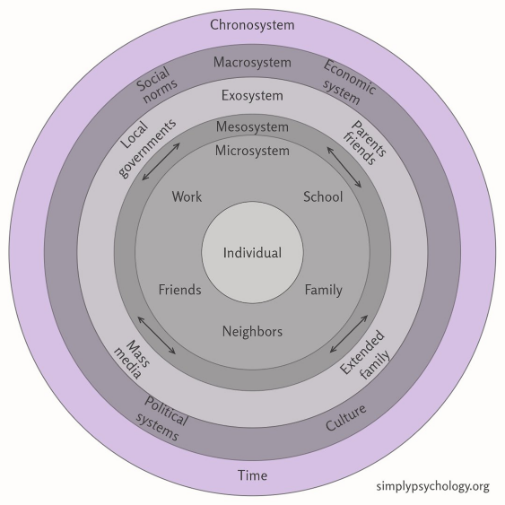
In his ecological systems theory, Urie Bronfenbrenner describes how various systems influence a person’s development. He argues that there are five interrelated systems that impact a person’s development as an individual. [See image on right]. These systems exist through people and our relationships with them, not the inanimate abstract idea of a system. A child growing up in poverty will certainly experience the world differently than one who grows up in a household with financial means, but not every person who experiences similar socioeconomic circumstances will have the same relationship with money. For example, a child in an affluent family with parents who use money to buy a their affection or good behavior will view their finances as an adult differently than a child from an affluent family with parents who don’t conflate resources with love.
The emotional experience one has within a specific situational is directly influenced by the people involved so each context is unique, multi-layered, and mutually influential. This is why two siblings growing up under the same roof will have different views of their parents; not only does each child have a unique relationship with each parent, each parent also has a unique relationship with each child. Likewise two neighbors can experience a third neighbor differently or two colleagues may have different views of the organization they work for, each based on their own life experiences and relational interactions.
From the very real systems and structures that surround us to the energy in a room, the mood of a crowd, or corporate expectations and pressures, we can see how we are influenced by our environment. None of us is an island. We are all, always, in relationship with the emotional world of the people around us.
This has profound implications for how we think about our own emotional health and our responsibility to each other.
What Is Co-Regulation?
Co-regulation is the process by which one person’s nervous system influences another person’s, helping to calm and stabilize it, often without either person being fully aware it’s happening.
The concept comes from developmental psychology, where it was first observed in the relationship between caregivers and infants. Babies can’t regulate their own nervous systems; they depend entirely on the presence of a regulated caregiver to help them settle. Over time, through thousands of co-regulatory experiences in a healthy parent-child relationship, children gradually develop the capacity to self-regulate.
But here’s what’s crucial to understand: we never fully outgrow our ability to co-regulate.
The capacity for self-regulation grows, yes, but even the most emotionally mature adult is still affected by the nervous systems of the people around them.
The Idea of a Regulated Presence
This doesn’t mean that we’re at the mercy of other’s emotional reactions or mature adults never get activated or agitated, but that when we become aware of these influences we can work to respond more intentionally. Our own steadiness can help those around us feel safer, which in turn helps our system stay regulated. We call this being a regulated presence.
This is not a burden or a performance; It’s not about suppressing your emotions so others feel comfortable. It’s a natural byproduct of doing the inner work (as discussed in the previous posts in this series, which are linked below). When you tend to your own nervous system, you become more available to the people around you.
We do this for others and others do this for us.
What This Looks Like in Practice
We need each other, so it’s important to do our own work and to build community. Here are some places to start:
Identify Your Anchors
Who in your life helps bring you back to your window of tolerance? Who do you feel genuinely calmer around? Invest in those relationships. Be intentional about spending time with them, especially when things are hard.
Notice Your Impact
Who do you have a steadying effect on? You may not think of yourself as a regulated presence, but chances are someone in your life experiences you that way. Becoming aware of your impact connects the inner work you’re doing with something bigger than yourself, and can nurture your own growth.
Seek Out Intentional Spaces
Therapy, support groups, faith communities, group classes are all spaces where people are deliberately working on themselves and showing up for each other. These offerings can provide a kind of relational nourishment that casual connection often can’t.
Let People In
Community requires connection which requires vulnerability: letting people see you when you’re not okay, trusting that the relationship can hold that, and offering the same in return. That’s a practice, not a one-time decision, and it is as difficult as it is simple.
You Don’t Have to Figure This Out Alone
The goal is never to become someone who doesn’t feel things, who never gets activated, or who can listen perfectly every time. The goal is to know ourselves a little better and find ways to stay connected with ourselves and with others, even when things are hard.
That’s enough. That’s more than enough.
If this series has stirred a recognition, longing, or a sense that you’d like more support, we want you to know that we are available. Therapy can be a place to slow down, reconnect with yourself, and build the kind of inner and relational resources that make life feel more sustainable.
The door is open. You’re welcome here.
At Ampersand Counseling Collective, we work with individuals across Washington State who are navigating anxiety, burnout, relational challenges, and the particular difficulty of staying connected in a divided world. We offer individual therapy in Issaquah and on Bainbridge Island, as well as online therapy throughout Washington.
This blog is the final post in a four-part series based on a group I led about Navigating Big Emotions in our Social/Political Climate. Part one covers emotional triggers and the window of tolerance, part two is about grounding strategies and emotional regulation, and part three explains how listening is transformative.