
Last week, I had the pleasure of speaking to nearly 100 undergrad students at the University of Washington. A dear friend of mine is a professor of religion and he invited me to speak to his class on the topic of what makes “a life worth living.” The basic premise is, as the course description reads;
Students ask what makes life worth living and discover sources of meaning and ethical maxims, as well as tools to navigate decision-making and fashion a flourishing life.
I had been thinking about this very question since my master’s program at The Seattle School of Theology and Psychology. I spent the first year of grad school reading, researching, and exploring answers to the questions: What is a human fully alive? What does it look like for a person to flourish? Being trained for a profession that often looks at “what’s wrong,” we were asked to consider what it is that we’re hoping to move towards, what is human flourishing? This theological anthropology paper was an exploration of the very nature of being human in light of ourself, others and God.
With this previous research as the foundation for my lecture, I proposed are two things that make a life worth living: connection and play.
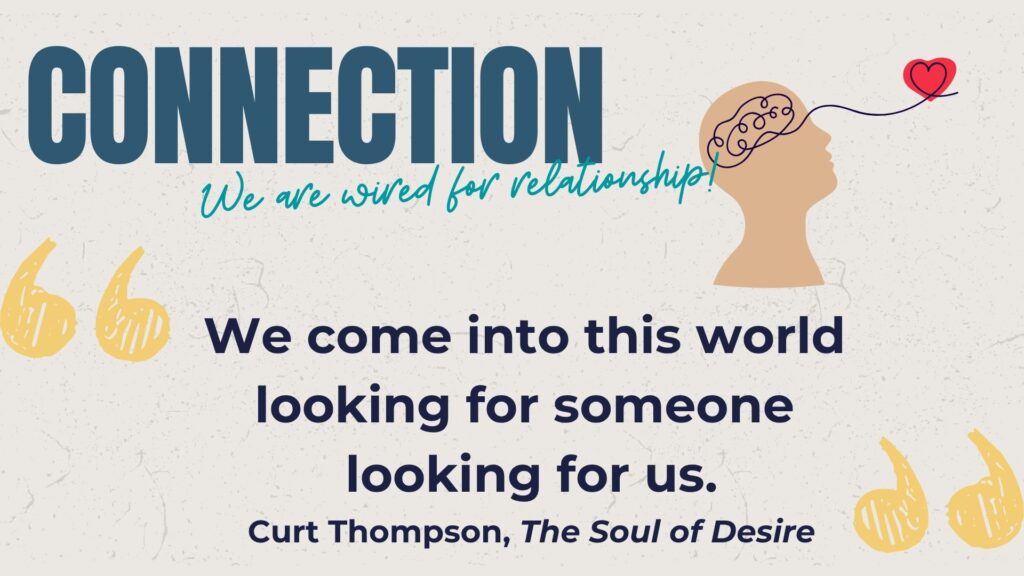
Connection: We Are Made for Relationship.
In his book, The Developing Mind: How Relationships and the Brain Interact to Shape Who We Are, Dr. Dan Siegel, a pioneer in the field of interpersonal neurobiology, writes that our “motivational drive to seek proximity to a caregiver and attain face-to-face communication with eye gaze contact can be viewed as innate or genetically ‘hard-wired’ in the typical brain from birth.” Simply put, our brains are wired for and by our relationships. With this in mind, I shared two kinds of connection that are essential for a life worth living: connection to self, which is a necessary precursor to connection with others.
Connection to Self
We experience connection to, and relationship with, ourselves through embodiment, emotions, and self-compassion.
Beginning with our bodies – nothing we do, and nothing that happens to us, happens without our bodies. We ARE our bodies, we don’t just have bodies. Author, researcher and therapist, Hillary McBride, says that embodiment is experiencing our bodies from the inside out; it is awareness of and through our five senses as we experience the world. Embodiment is the first part of connection to ourselves and we need to have some level of embodiment before we can be aware of our emotions.
Emotions happen inside the body and are expressed through our bodies. Health and flourishing require having access to a full range emotions. The ability to experience our emotions is central to our well-being, both intrapersonally (within ourselves) and interpersonally (within our relationships).
- Intrapersonally – our emotions enable us to process and make sense of our lived-experiences. They provide data about our environment, highlighting danger, pointing to boundary violations and signaling loss. This internal navigation system becomes the bedrock for processing our experiences, fostering adaptability, building resilience, and improving our decision making.
- Interpersonally – our emotions serve as social cues that enable us to have deeper relationships with others and communicate our needs. They helps us connect to others.
Lastly, connection to ourselves requires a relationship with ourself that is rooted in self-compassion. Grounded in radical self-love, self-compassion is an acceptance of your authentic self and your inherent value. It is the ability to hold a fuller picture of ourself—the good, the bad and the ugly—and have empathy and kindness for yourself. Dr. Kristen Neff, leading expert on self-compassion, identified three pillars of self-compassion:
- Choosing self-kindness over self-judgement.
- Recognizing common humanity rather than self-isolation.
- Mindfulness of emotions rather than over-identification.
Without a connection to and relationships with ourselves, we will not able to have meaningful connection with others.
Connection to Others
Connection with others involves authenticity, vulnerability, and reciprocity/mutuality.
I like to say that authenticity is when your insides match your outsides. There’s a sense of being without pretense or performance. Gabor Maté calls authenticity “the quality of being true to oneself.” Without authenticity our relationships are insincere, superficial and performative. They lack the realness of being with someone else in a meaningful and connective way. We need authenticity before we can have vulnerability.
Author and shame researcher, Brené Brown writes that vulnerability is “sharing our feelings and our experiences with people who have earned the right to hear them.” Or put another way, vulnerability is risking honesty of self (authenticity!) with another person. Authenticity and vulnerability work together to build connection and intimacy. It takes tremendous courage to bring the fullness of your authentic self and vulnerably share yourself with another person, and yet it is connection that we are made for. We are made for relationship and thus connection with others also requires reciprocity.
Reciprocity is the mutual giving and receiving of self. It is an exchange of support, care and energy between people in a way that feels balanced. Rather than a strict “tit-for-tat” transaction, reciprocity is a dynamic back-and-forth rhythm where both people feel their needs are valued and met. Healthy relationships are not one-sided but instead are a continuous flow of mutual interchange and reciprocity.
Play as an Essential not an Extra.
The second essential I proposed for a life worth living is play.
Child psychiatrist and psychoanalyst Donald Winnicott argues that play is a natural, universal, basic form of living that facilitates growth and belongs to health. As children, play is our form of communication; it’s how we make meaning of our experiences. (This is why Play Therapy can help children heal.) Play also facilitates connection, both with others and to ourselves. And this continues even as adults. I have written elsewhere that play is a liminal space between what is real and what is imagination; it can be a place where we can try out different parts of ourselves, inviting us to know more about ourselves, our desires and others.
Many scientists, philosophers and artists over the centuries have tried to define play. It feels present and alive yet somehow illusive to pin down. One medical doctor and clinical researcher, Stuart Brown, founder of the National Institute for Play, came up with these seven properties of play:
- PURPOSELESS – play is an activity that has no survival value and is done for it’s own sake.
- VOLUNTARY – there is no obligation or demand to participate; it is not required and we choose to do it.
- INHERENT ATTRACTION – play provides psychological arousal; it is fun and makes us feel good.
- FREEDOM FROM TIME – there is sense of losing time when engaged in play.
- DIMINISHED CONSCIOUSNESS OF SELF – one stops worrying about looking good/bad, smart/stupid, etc. and is fully in the moment.
- IMPROVISATIONAL POTENTIAL – play has an openness to change; one is not locked into a rigid way of doing things. There’s a flexibility to it.
- CONTINUATION OF DESIRE – simply, we want to keep doing it!
Play is so many things and varies from person to person. It could be playing a board game, singing karaoke, hiking in the woods, reading a good book, hanging out with friends, gardening, painting, sports, music… and so much more. Play is a way we can feel alive and connected to ourselves and others.
Agency To Build A Life Worth Living
In the end, what I had hoped to impart to these students is that on some level, they have agency to choose the kind of life they want to build. Only you live your life, no one else. And through my own journey on this wild ride we call life, I have found that a few essentials for a life worth living include connection/relationship (to self and others) and play.
For reflection:
- What are the ways you connect with yourself?
- How do you connect to others?
- How do you like to play? With whom and where do you play?
- What are barriers or obstacles to your play?
📚 Works Cited & Suggested Reading
Brown, Brené. Daring Greatly: How the Courage To Be Vulnerable Transforms The Way We Live, Love, Parent and Lead. New York, NY: Avery, 2012.
Kimmerer, Robin Wall. Braiding Sweetgrass: Indigenous Wisdom, Scientific Knowledge, and the Teaching of Plants. Minneapolis, MN: Milkweed Editions, 2013.
Maté, Gabor and Daniel Maté, The Myth of Normal: Trauma, Illness & Healing in a Toxic Culture. Middletown, DE: Everrin, 2022.
McBride, Hillary. The Wisdom of Your Body: Finding Healing, Wholeness, and Connection through Embodied Living. Grand Rapids, MI: Brazos Press, 2021.
Neff, Kristen. “What is Self-Compassion?” at The Center for Mindful Compassion. 2026. https://centerformsc.org/pages/what-is-self-compassion
Siegel, Dan. The Developing Mind: How Relationship and the Brain Interact to Shape Who We Are, 3rd Edition. New York City, NY: Gilford Press, 2020.
Thompson, Curt. The Soul of Desire: Discovering the Neuroscience of Longing, Beauty and Community.Downers Grove, IL: InterVarsity Press, 2021.
Winnicottt, D. W. Playing and Reality. Tavistock Publications, 1971.
One response to “Connection And Play: Essentials for “A Life Worth Living””
[…] requires connection which requires vulnerability: letting people see you when you’re not okay, trusting that the relationship can hold that, […]